
Guides / Short-term Rental
How to Get More Bookings on Airbnb: Ten Field-Tested Levers
A practical playbook for short-term rental hosts in 2026 — hero photos, dynamic pricing, reviews, Instant Book, and considered virtual staging. Ranked by impact-per-hour.
The short answer
Airbnb booking rate is mostly a function of three compounding levers: how many searchers click the cover photo (CTR), how many of those convert to a booking (listing quality and price), and how many guests leave positive reviews (trust). Improving any one of the three visibly moves bookings; improving all three is how hosts get to Superhost.
The single highest-ROI move most hosts can make this week is replacing the cover photo. The highest-leverage ongoing habit is disciplined pricing. Everything else stacks on top.
More for short-term rental hosts: see Vestaro for Airbnb hosts — the cover photo, the gallery, and the long-term mechanics that move bookings.
1. Fix the hero photo first
On every Airbnb search result the cover photo is 80% of the real estate. If guests don't click, nothing else you do matters. Three characteristics show up consistently in high-performing covers:
- Shot wide, in landscape, at eye level. Vertical phone photos lose 20–30% of visible space to crop.
- Real light, no ceiling fixtures on. Mixed lighting (warm bulbs against cool daylight) reads as amateur even when the room is nice.
- One clear focal point per frame. A made bed, a styled sofa, a view through the window — not all three at once.
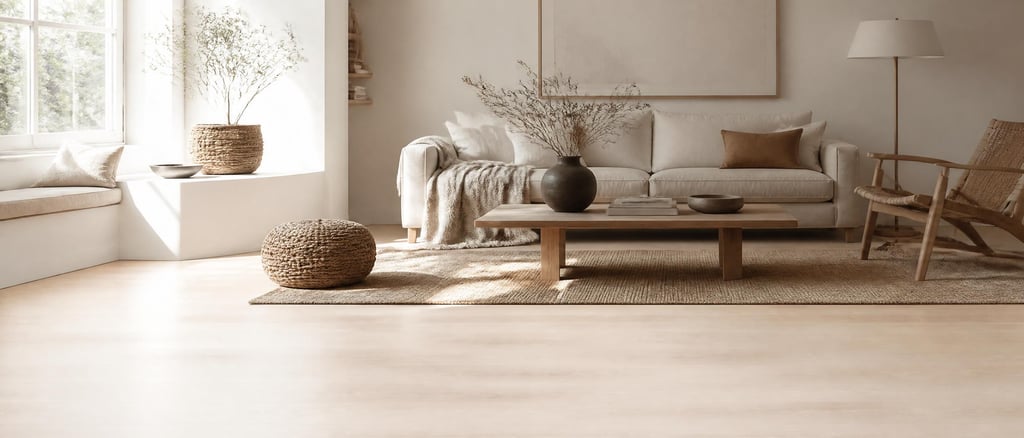
If you can afford one thing on this list, this is it. Hire a real-estate photographer for $150–$300 or, if the space is already photogenic but bare, try the considered staging approach in section 7.
2. Get the pricing right
Mispriced listings are the second-most-common cause of empty calendars. Two failure modes:
- Flat pricing all year. A single nightly rate for peak and off-season leaves money on the table in high season and kills occupancy in low.
- Too high relative to comps. Airbnb ranks listings partly on booking conversion rate. Pricing above comps for weeks drops you in search, which further tanks conversion — a feedback loop that's hard to climb out of.
Dynamic pricing tools — PriceLabs, Beyond, Wheelhouse — typically pay for themselves within the first month. If you're not using one, even Airbnb's free Smart Pricing is better than a flat rate. Cross-check with AirDNA or Rabbu for what comparable properties actually earned in your market.
Rule of thumb: under 50% occupancy in peak months means priced too high; over 95% in peak means priced too low and giving up revenue.
3. Rewrite the title and description
Airbnb shows about 50 characters of the title before truncating. Use them on concrete differentiators, not adjectives:
- Weak: "Beautiful cozy modern apartment"
- Strong: "Walk to Pike Place · Rooftop hot tub · Sleeps 6"
For the description, front-load the first paragraph with the three facts guests need to decide: who it's for (couples, families, business travellers), the single best feature, and the nearest landmark. Save the full amenity list for the later sections — guests scroll only if the opening hooked them.
Skip emoji walls and exclamation marks. They read as desperate to experienced travellers and get filtered out by corporate bookings.
4. Turn on Instant Book
Airbnb's ranking algorithm gives a measurable boost to Instant Book listings, and a growing share of guests filter for it directly — particularly on same-day and next-day searches. Turning it off cuts you out of that demand entirely.
If screening feels risky, Instant Book still lets you require government-ID verification, at least one prior positive review, and strict house rules the guest must acknowledge. Those three toggles eliminate the vast majority of problem bookings.
5. Respond within an hour, every time
Response rate and response time are ranking factors, and they're two of the four Superhost criteria. More concretely: 70%+ of inquiry-to-booking conversion happens in the first hour after a guest reaches out. After 24 hours, they've booked someone else.
Set up Airbnb's saved messages for common questions (check-in time, parking, Wi-Fi password) and enable mobile notifications. With multiple listings, consider a co-host or property-management tool like Hospitable or Hostaway to maintain one-hour response times.
6. Build review velocity
A listing with ten or more recent positive reviews converts roughly three times better than one with fewer than five. Two practical things actually work:
- Review guests first, always. Airbnb reveals reviews only when both parties submit — reviewing promptly prompts guests to do the same. Do it the day after checkout, not two weeks later.
- Send one specific message after a great stay. "Thanks for being a great guest — if the place worked for you, a quick review helps us a lot." Generic "please review us" messages underperform.
Never bribe for reviews — Airbnb detects discount-for-review patterns and penalises. Focus on delivering an experience worth reviewing, then make reviewing easy.
7. Upgrade the gallery — including considered staging
Beyond the cover photo (section 1), the full listing gallery is where bookings are won or lost. Guests who click through expect 15–25 photos covering every room, the exterior, and any signature feature (view, pool, workspace). Gaps trigger doubt.
Standard upgrades: hire a local real-estate photographer, shoot exteriors at golden hour, and include at least one human-scale photo with real light streaming in. If the property is already styled well, that usually ends the story.
Where it gets interesting is the middle case: a fresh listing that isn't furnished yet, a property between long-term tenants, or a dated interior that's impractical to redo before listing. Considered virtual staging — adding furniture and décor to empty or outdated rooms — is a legitimate tool to honour the room's bones and show guests what the space can feel like, without physically buying and moving furniture.
The constraint is honesty: the room layout, flooring, walls, and windows in the photo must match reality. What virtual staging can reasonably do is add a rug, a bed frame, a sofa in the scale a future guest might experience once you or they bring items in — or, for furnished listings, swap dated pieces for quieter modern ones that photograph better. What it cannot do is hide flaws, invent views, or imply amenities that aren't there.
Vestaro renders photographer-grade staging across the gallery — same furniture, real light, real materials, the same considered look on every angle. If photos are specifically where the listing is losing clicks, the Airbnb listing photo upgrade playbook walks through the four most common photo problems hosts have — flat shots, daytime exteriors, clutter, dated furniture — and matches each to the fastest fix.
8. Add the amenities guests filter for
A surprising number of bookings are lost because the guest filtered on an amenity you actually have but didn't tag. Walk through Airbnb's amenity list and tick everything that genuinely applies:
- Wi-Fi speed (guests filter for >50 Mbps for remote work)
- Dedicated workspace with a real desk
- Washer and dryer
- Free parking on premises
- Air conditioning (non-negotiable in summer markets)
- Pets allowed (massive filter — even with a fee, turning it on helps)
If you're missing one that's cheap to add (a real desk, a pack-and-play for infants, a baby gate), the math almost always favours adding it. Each amenity tag widens the share of search.
9. Earn and keep Superhost status
Superhost is one of Airbnb's strongest ranking signals and one of the few badges guests actively filter for. The criteria, assessed quarterly:
- 4.8+ overall rating across the last 365 days
- Ten or more completed stays (or 100+ nights across three or more stays)
- Less than 1% cancellation rate
- 90%+ response rate within 24 hours
Each is a behaviour, not a number to hit. If you consistently respond fast, never host-cancel, and treat cleanliness as non-negotiable, the badge is downstream. Hosts who lose Superhost usually do so because of a single bad week — a tanked review or a forced cancellation — not gradual drift.
10. Promote outside of Airbnb
Direct bookings and listings on secondary platforms don't just add revenue directly — they also feed Airbnb's algorithm. Properties with off-platform momentum (social traffic to the listing, repeat guests) tend to rank higher over time.
- List on Vrbo and Booking.com if the property type fits (Vrbo for families, Booking.com for international).
- Build a simple direct-booking page. Hostfully or OwnerRez let you accept direct bookings at lower fees than Airbnb's.
- Post on Instagram and local Facebook groups. "Considered loft in [neighbourhood]" content outperforms generic listing links.
Don't spread too thin. Pick one extra channel, get it working, then add the next.
Topics
Related guides
Frequently asked
Why am I not getting bookings on Airbnb?
Three causes cover most cases: the hero photo doesn't earn the click on the search grid, the nightly price is misaligned with comparable listings, or the review count is too low to build trust. Fixing the hero photo is usually the cheapest win; pricing is the highest-leverage; reviews compound over time.
How long does it take to start seeing more bookings after I optimise a listing?
Airbnb re-scores listings continuously, but the biggest jumps tend to show up within two to four weeks after a material change (new photos, new price, Instant Book on). Review-driven lift is slower — you need three to five new reviews to move the trust needle, which typically takes a full booking cycle.
Do better photos really affect bookings, or is that folklore?
Airbnb's own data team has publicly credited cover-photo quality as one of the strongest predictors of click-through from search to listing. Third-party hosting tools like AirDNA and PriceLabs report similar patterns. If your click-through is below 3%, the photo is almost always the problem.
Is virtual staging against Airbnb rules?
Virtual staging is allowed as long as the photo still represents the space accurately. Walls, windows, flooring, and room layout must be real; what you add — a rug, a sofa, a quieter bed frame — has to be either present in the listing or clearly labelled as a staging reference. Misleading staging (fake windows, removed flaws) gets listings delisted and reviews penalised.
Should I turn on Instant Book?
For most hosts, yes. Airbnb's ranking algorithm gives a measurable boost to Instant Book listings, and guests filter for it. The risk is fewer screening opportunities — mitigate it with strict house rules, a minimum-stay floor, and government-ID verification requirements.
How much should I spend on improving an Airbnb listing?
A useful rule of thumb: spend up to one month of expected revenue on one-time listing improvements. If the listing earns $3,000 a month, a $300–$500 investment in new photography, considered staging, or a paid pricing tool usually pays back inside the first improved month.
Is Superhost status worth chasing?
Yes, but don't force it. Superhost is granted on real performance — response rate, cancellation rate, 4.8+ rating, ten or more stays a year. Chasing the badge by gaming numbers leads to burnout. Focus on the underlying behaviours and the badge — plus the ranking boost — follows.
About the author
Vestaro Studio
The editors at Vestaro
The Vestaro studio publishes guides on real estate photography, virtual staging, and the business of selling a listing through the photos that lead it. Pieces are written by the team — photographers who shoot listings, engineers who train the staging models, and agents who use the output to close deals — and edited together before they ship.
We write from the field rather than from a content calendar. When a guide references a price, a turn-time, or an MLS rule, that number reflects what the team has observed across the listings we render each week. Where a topic touches a market we don't sell into, we say so.